PART 2 · Tools
Reading Elliott Wave with Redhat
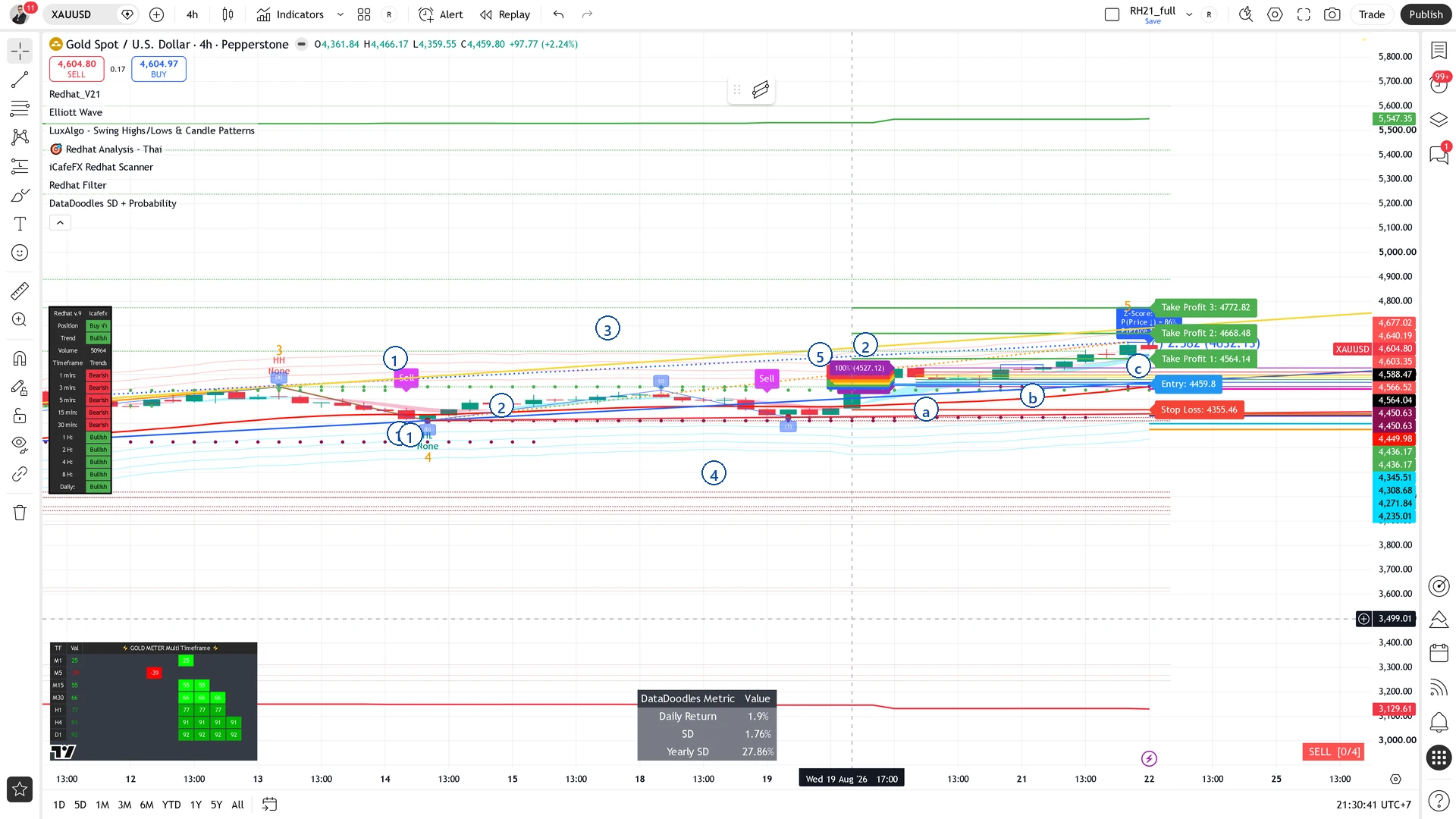
Elliott Wave is the art of counting market waves — it says the market moves in waves: 5 large waves (pushing forward) followed by 3 waves (pulling back). Redhat counts the waves and labels (1)(2)(3)(4)(5)(a)(b)(c) for you right on the screen
Chapter summary video
Real chart screen recording · not investment advice
Listen to the TL;DR summary of this chapter
TL;DR
Elliott Wave is a way of counting the waves of the market — 5 push waves + 3 pull waves. Redhat counts the waves and labels them on screen; wave 3 is the strongest and (2)(4) are often entries — but wave counting is interpretation, it can redraw, so never hold it as iron law
1 · What is Elliott Wave
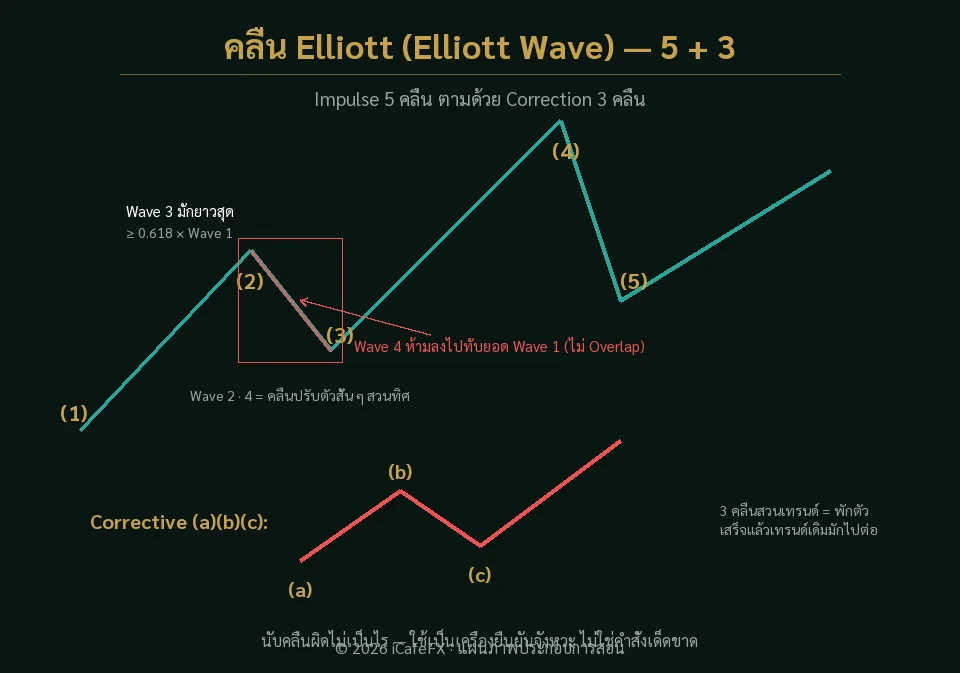
Elliott Wave is the theory that the market moves in waves — 5 large waves (pushing in the same direction) followed by 3 smaller waves (pulling back)
Redhat already has the Elliott Wave switch built in — it can count waves and label (1)(2)(3)(4)(5)(a)(b)(c) automatically — but in the current state label display is turned off, so users count from the swing points themselves
Elliott = counting market waves, 5 push 3 pull; Redhat helps point out the swings, the user does the counting
2 · How to count waves on the Redhat screen
Redhat has automatic labels when enabled (currently turned off): push waves = (1)(2)(3)(4)(5), pull waves = (a)(b)(c); each label sits at the high or low of its wave
The rule it applies: wave 3 must not be shorter than wave 1 × 0.618 (W3 ≥ 0.618 × W1); if it is shorter = miscounted, and the system redraws
If the labels look too small to read = zoom the candles larger or scroll the chart to a stretch where the waves are clear — not every stretch has a full 5 waves
3 · How to recognize the waves
Remember 2 key points: wave 3 is the strongest and usually the longest, and (2) and (4) are usually where price turns = the entries Elliott traders watch
- Wave 3 — the strongest, usually the longest, where the trend accelerates
- (2) and (4) — turning points, often entries
- (a)(b)(c) — the pull-back waves after wave 5
"Waves can change — counting is a guide, never bet your life on it"
4 · The honest scope: wave counting is personal
Said plainly: wave counting is personal — no two people count exactly the same, and as price moves on Redhat may redraw the labels with numbers changed from before
So: use Elliott as a supporting guide, not an iron law to bet your whole account on
Elliott can redraw — seeing labels change is normal; do not panic and never make it your absolute reason to enter
This chapter in one line
Elliott = counting waves, 5 push 3 pull; Redhat labels them, wave 3 is the strong one and (2)(4) are entries — but wave counting is interpretation, it can redraw, never treat it as iron law